Baz Luhrman’s Romeo + Juliet (R+J) is known to everyone for many different reasons. It could be for its Catholic aesthetic, costume design, Mercutio’s performance, or because of Leonardo DiCaprio’s sad eyes and blonde curtains. Cinephile or not, this movie is probably familiar to you one way or another. 30 years after its release, it’s considered a cult classic, but would you believe it was quite the opposite when it hit theatres in 1996? Critics were appalled at the ‘bastardisation’ of Shakespeare, labelling it as ‘gaudy’ and ‘tacky’. While it still is a belief today, I want to explain to you why the critics are short-sighted and blind to the use of revolutionary visual language. Before 10 Things I Hate About You, She’s The Man, and Never Been Kissed, there was the first domino to fall.
In fair Verona Beach, where we lay our scene…
Luhrmann departed from the original setting of the play, using a Californian backdrop that’s plagued with gang wars and corruption. The two families, Montague and Capulet, are portrayed as Godfather-esque crime lords whom the police struggle to control. Their feud is violent and merciless, putting civilians in danger and allowing young men to play God. Luhrmann’s “postmodern excess” is difficult to argue with, blending fiction with the startling reality of the 90s; he critiques a society we are familiar with. Even Friar Laurence is not safe from Luhrmann’s judgment, a holy figure who supplies drugs to teens. The thematic use of drugs is not a promotion to the viewer, as some critics might think, but a tool to highlight the corruption of the Catholic Church in contemporary life. Friar Laurence is not simply a supplier but a manufacturer, being the source of sin while upholding a role dedicated to absolving it. He is the embodiment of corruption within the Catholic Church. This is not to say Laurence is necessarily the oppressor, as we do see him consume his own product, which suggests to us that he is as trapped in a cycle of destruction as his peers. He is just another pawn in the decline of Verona Beach. The use of Shakespeare’s “high culture” status highlights the moral collapse of real society, distinguishing this adaptation from its predecessors.
Not only was the modern setting a problem for critics, but so was the dialogue, or lack thereof. It’s no surprise that any Shakespearean text is heavily worded, not something that can be translated well into cinema, especially one aimed at teens. So while Luhrmann maintained the old-timey language, there were necessary cuts which critics saw as a “dumbing down” from the original. However, a lack of dialogue does not negate the existence of other forms of engaging language or sophistication. The visual language in R+J redefined the lens through which we view Shakespeare.
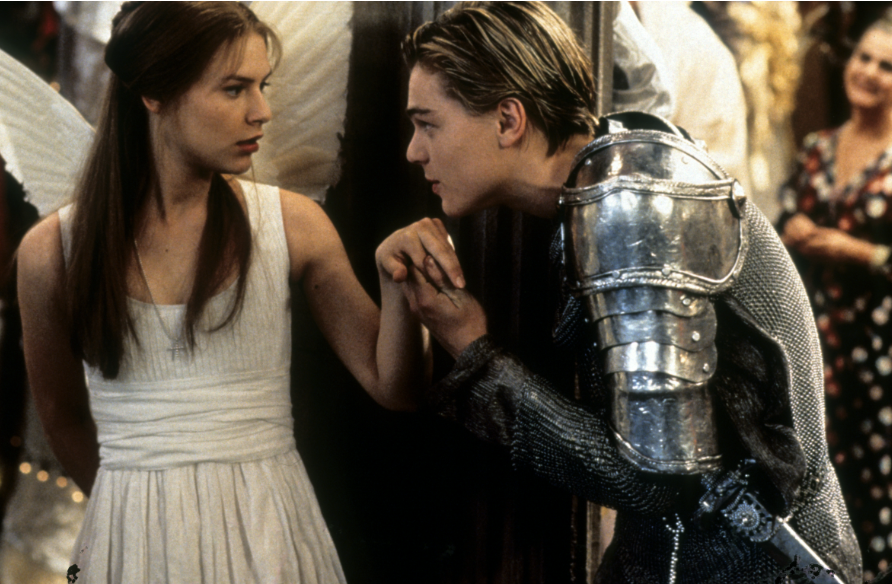
The reduction of dialogue created an opportunity for music, colour, movement and even costume design to tell the story. This is seen particularly in the characters Mercutio and Lady Capulet. Elsie Walker wrote that Mercutio dressing in drag is suggestive of being an outcast, and his theatrical flair implies he’s rarely taken seriously. While Walker also writes that Lady Capulet’s thick makeup, vanity and flirtatiousness with Paris portray her character as selfish and a direct contrast to Juliet’s personality. Even the clever use of the costumes from the Capulets’ party is a mode of language that subtly informs the audience of the characters’ portrayal without explicitly saying anything. For example, Paris’ preppy look and old-money smile create a strong similarity to JFK. Additionally, Juliet’s costume of an angel makes us associate her with innocence and kindness, while Lady Capulet’s Cleopatra costume symbolises ruthlessness and ambition. Appointing each character with a unique set of physical traits that relates to pop-culture helps the teen viewer engage with the plot and brings a sense of relatability to a centuries old play. And thus, a relationship between “high” culture and “low” culture is born. This is further cemented by Luhrmann’s small nods to the original text by engraving the guns with “long sword” etc., and naming the billiards room “The Globe”. As Arturo Pizano puts it, “the text must fight to stay relevant and alive rather than relying on its reputation and status”.
Even though this film is overtly an adaptation, critics branded it the furthest thing from Shakespeare. To that, I pose the question: can anything that wasn’t directed by the man himself be “Shakespearean”? How can we authentically reproduce a play that has been around for centuries? The phrase “Shakespearean” is arbitrary when applied to any modern performance. The Cambridge dictionary depiction of adaptation is “the process of changing to suit different conditions”, and that is exactly what R+J provides. Luhrmann makes changes that are compatible with the modern audience who may not be familiar with Shakespeare, all the while continuing to trigger the emotive responses of audiences for 400 years.
R+J faced an injustice 30 years ago that was a result of the high-brow, intellectual elitism of critics who ignored cinematic splendour for ‘sophistication’. Over the years, it has matured with its audience and summed up to simply being ahead of its time.
Hi I’m Jaz! I like talking about art and films. Check out my socials @unde.rthewillowtree for more.