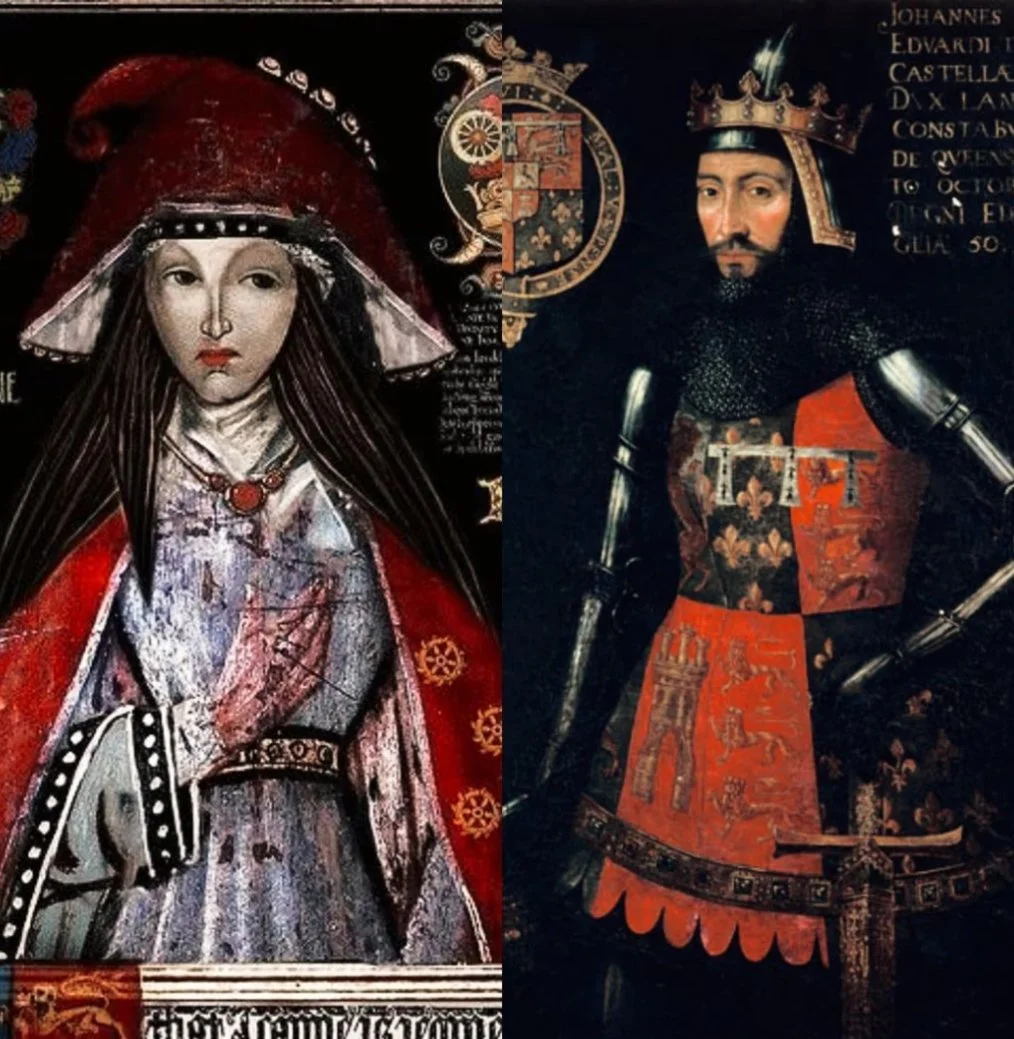
Katherine Swynford was never meant to be one of the most consequential women in English history… and yet, through a combination of love, loyalty, and frankly a baffling number of royal pregnancies, she helped found a dynasty that would become the Tudors. Her life was marked by scandal and romance (naturally), but also by shrewd navigation of the treacherous waters of Plantagenet England. She went from a respectable knight’s wife to the actual ancestress of kings. The definition of a glow-up, if there ever was one.
Katherine was born around 1350, likely in Hainault (modern Belgium-ish), the daughter of Payne (or Paon) de Roet, a knight of modest standing who hailed from the Low Countries. He worked in the service of Queen Philipa of Hainault, Edward III’s queen, which is how Katherine ended up in England. Picture a medieval internship programme, but with much more embroidery and not even the whisper of an HR department.
She had at least three siblings, one of whom was Philippa de Roet – not to be confused with the many other Philippas floating around. This Philippa married a poet called Geoffrey Chaucer. Perhaps you’ve heard of him? Katherine’s early life is not well documented, because (no offence, Katherine) her birth would have suggested she was small fry at best. Certainly not one to be… frolicking… with royalty. It is, however, believed she was educated and well-positioned to become a lady-in-waiting or companion to a noblewoman (yes, this is essentially getting paid to be someone’s friend). Such a role brought her into the orbit of the powerful House of Lancaster.
By the early 1360s, Katherine was married to Sir Hugh Swynford, a Lincolnshire knight who was roughly a decade older than her… because of course he was – this is still very much the age of egregious age-gap marriage that would stop any second thoughts about Aaron Taylor-Johnson. Together, Katherine and Hugh had at least two children. Well, that we know of. Their daughter, Blanche, possibly became a nun, but was also possibly married off. As I said, the details at this point of Katherine and her young family are hazy at best. Thomas Swynford, the second child who definitely came from Katherine’s marriage to Hugh, went on to become the Constable of Pontefract Castle. The eagle-eyed among you will be finding this equally as sus as me. Quick tangent: Pontefract Castle is the same place where Richard II died under mysteriously convenient circumstances… shortly to be deposed by none other than Henry IV, who just so happened to be Thomas Swynford’s half-brother. Now I’m not casting any dispersions – I’m just going to leave that titbit of information there…
There were potentially two other daughters from this marriage, maybe a Margaret, maybe a Dorothy, but medieval record-keeping was less “family tree” and more “mysterious shrub”. What we do know, however, is that while married to Hugh, Katherine entered the household of John of Gaunt, Duke of Lancaster (and fourth son of King Edward III), as governess to his children by his first wife, Blanche of Lancaster. I say first wife, because Gaunt was no stranger to a wedding. He’s no Henry VIII, but we’ll get on to John’s matrimonial.
Sadly, Blanche died in 1368. Katherine, becoming a widow herself only a few years later, got a promotion. She wasn’t just the governess to Henry Bolingbroke – future Henry IV – she was supplementing these duties (I believe the term now is a side hustle) and became Gaunt’s mistress. Their affair, which seems to have started in the early 1370s, had everyone in the Plantagenet court clutching their pearls, metaphorically and potentially literally; Edward III had a reputation for picking things up and creating chivalric orders out of them. But Gaunt, one of the richest and most powerful men in the kingdom, was a massive catch, and the man fell hard. Aweee. The happy couple had four children: the Beaufort children. Ring any bells? Well, their first son, John, was the grandfather of Margaret Beaufort, mother of Henry VII. Their other children did not shrink into obscurity either. Their second son, Henry, was a major political force, holding the title of the Bishop of Winchester; their third son was a key military figure as a Naval commander in the Hundred Years’ War; and their daughter Joan married the 1st Early of Westmorland. Notable children they produced include Cecily Neville, the mother of Edward IV and Richard III. As I said, less tree, more shrub, or perhaps even a wreath. In other words, the Plantagenet royal family was about to be very, very Beaufort-shaped. Now, take a shot every time I’m about to say Beaufort: as illegitimate children, the Beauforts clearly could not take the name of their father; it is thought ‘Beaufort’ (beautiful stronghold – arguably a bit much for a surname) comes from John Beaufort’s believed birthplace in Gaunt’s castle and manor of Beaufort in Champagne. Still with me? Despite their illegitimacy, they would be raised as aristocrats and deeply integrated into royal society.
However, despite having several children with Katherine, Gaunt also had a royal duty. While he was on his second wife (although marriage didn’t entirely stop Gaunt and Katherine’s… liaisons), Katherine’s role was more discreet. Their affair had caused a great scandal, and the marriage of Gaunt and Constance of Castile was a royal alliance meant to strengthen his claim to the Castilian throne. Katherine, during this period, largely retreated to her own estates in Lincolnshire and lived quietly as a respectable widow… with her brood of illegitimate children. Here she raised her Beaufort children in relative seclusion, though they were well cared for and positioned socially. Gaunt never publicly disowned Katherine or their children, and it’s clear from later events that he remained emotionally and financially connected to her.
Some suggest Gaunt may have distanced himself for political reasons more than personal, especially as his Castilian ambitions required diplomatic appearances. But Katherine’s long-term influence endured. She remained a loyal figure in his life. Indeed, the couple didn’t wait long after Constance died. The pair finally married in January of 1396. If the affair had the court whispering, the marriage was truly shocking to many. Katherine had not only been his mistress for decades, but she was also far below him in rank – the horror! Their children were legitimised by royal and papal decree, though with one critical clause: they were barred from inheriting the throne. Which is adorable, considering how well that worked out later.
Sadly, however, they only managed to enjoy three years of matrimonial bliss before Gaunt died in February 1399. Katherine lived until May 1403. She was buried in Lincoln Cathedral, next to John of Gaunt. A beautiful tomb was erected for them, and though damaged over the centuries, it still exists today. Her epitaph referred to her not as a royal mistress, but as the Duchess of Lancaster – a final mark of the legitimacy and respectability she had gained by the end of her life. Katherine’s real influence lay not in her lifetime politics but in her genealogy. Through her daughter, she became the grandmother to the powerful Neville family. Through her son John, she became the great-great-grandmother to Henry VII. Katherine Swynford is, therefore, a critical link between the Plantagenets, the Lancastrians, the Yorkists, and the Tudors – a rare feat, even in the incestuous web of medieval nobility.
Katherine Swynford’s life is the stuff of epic historical fiction – only it actually happened. She navigated the shifting sands of court politics with an iron will and a very busy uterus, managing to go from governess to duchess without ever being born into power. Through her children, she stitched together England’s most powerful noble families, laying the foundation for a royal dynasty that would rule for over a century, and still very heavily features in almost every History classroom in England. History may have once side-eyed her as a mistress, but time has rewritten her legacy: not just as the woman who loved a duke, but as the woman who mothered kings.
Katelyn is an editor, aspiring author, and history fanatic living in the south of England. She graduated from the University of St Andrews with a degree in English and is now attempting to navigate the chaotic world of adult responsibility in the ways she knows best: writing and having fun. When she’s not sat at her desk working or writing, she can be found swimming, embroidering, or spending time with her loved ones.