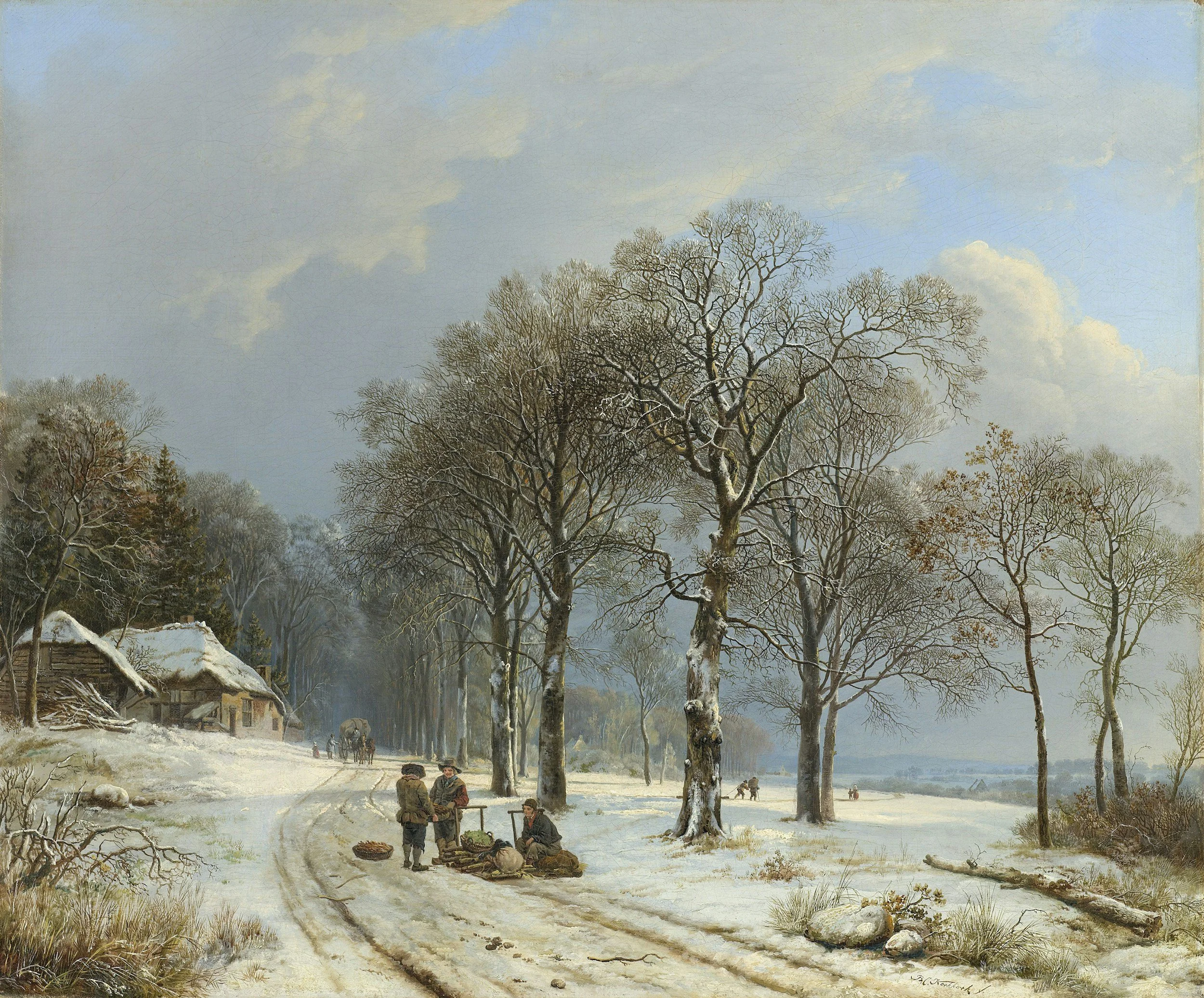
As the frosted wind creeps in from the North, the whispers of Gothic Winter begin to amplify. The seasonal itinerary should consist of: visiting a snow blanketed graveyard, strolling in the fog, befriending the local raven and waking with the moon. The best way to begin the festive season? Watching your favourite gothic film by candlelight. A few honourable mentions are Crimson Peak (2015), The Witch (2015), Sleepy Hollow (1999) and Nosferatu (2024). However, it wouldn’t be a gothic winter without Mary Shelley’s Frankenstein. This year’s movie adaptation, by Guillermo del Toro, blends the gothic and the Romantic period into a perfect watch for the witching hour. Alas, one cannot truly appreciate this winter essential without understanding the history behind it. To do that, let's go back to the late 18th century when Romanticism was born.
Picture this: the French Revolution has just happened, industrialisation is transforming the cities of Europe and religion has loosened its grip on society. After centuries of artistic constraint came a new age of freedom and expression. Gone were the times of following the rules. This new wave of Romantic creatives placed a new emphasis on the personal, channeling one’s thoughts, emotions and imagination through their respective mediums. Romanticism emerged as a reaction to the rapidly modernising world, offering a new set of beliefs that still shapes how we view the world today. As the world became increasingly more logical, rigid and sterile; the Romantic artists, writers and thinkers celebrated innocence, spontaneity and goodness. From Byron to Beethoven to Blake, their unifying attitudes to art and life differed drastically from those previously expressed. As Baudelaire said, “Romanticism is precisely situated neither in choice of subject nor in exact truth, but in a way of feeling”. This way of thinking found its name in the idea of ‘individual sensibility’, meaning rather than following the status quo, Romantics created from the soul. This resulted in the art from this period being pretty tough to categorise, because no two works were the same - like a fingerprint. This shift created an entirely new way of seeing the world, one through nature, emotion and elegance.
Alongside this new independence over art, literature and music, there was a stronger appreciation for beauty. While the industrial age was taking over the countryside, a fight for its preservation began in retaliation. One of the most famous British poets, William Wordsworth, was a part of the fight. When he moved to the Lake District, his entire perspective changed; he fell in love with the natural world and passionately defended it. Over nine years he produced literature that inspired many Romantic pioneers, worshipping the strength, brutality and peace of nature that eventually became a spiritual substitute for many.
As industry accelerated and the old ways crumbled, Romantics turned to art as their new form of devotion. Romantics no longer relied as heavily on the church, a power that had been at the core of European life for many centuries. The world was changing so quickly. Everything was being questioned and the merciless speed of industrialisation had created a vacuum in the art world. Romantics clung to art as their religion - rather than art being a symbol for faith, art had become wholly spiritual to them. The meditations of creating had replaced the act of prayer, an entirely new mode of personal expression. This paved the way for deeper passions to arise within artistic practice, found in the forms of sublime landscapes, emotive scenes and new genres.
The sublime was a key pillar to the Romantic Age, being defined as a landscape that elicits excitement, wonder and awe. Heightening the strength of the imagination through the chaos of the composition. Landscapes that stretch into the distance yet disappear into fog are classic examples of the sublime. It incites the imagination, the fear of the unknown, your brain runs away with itself wondering what’s there. You’re no longer simply an observer, as your imagination brings you closer to the scene and your empathy is heightened, you are now inside the art. However, this wasn’t limited to paintings. Romantic work across every medium evoked the same feeling: it articulated an emotion that you thought was yours alone.
So what happens when a 21st-century Romanticism fangirl decides to resurrect one of the movement’s defining novels? Guillermo del Toro’s adaptation cannot be classed as accurate to the text but that’s exactly the point. Del Toro stated in many press interviews the film encompasses “the spirit of the book”. Creating a film that was personal to him while illustrating visual skill, emotional richness and beauty. How very Romantic of him.
Del Toro’s attention to detail becomes a testament to not only Mary Shelley, but the Romantic period itself. The film is saturated in references to the age, from the sublime landscapes of the North Pole to the decision to centre war in the plot. A charming detail is that Shelley loved Edinburgh, so del Toro placed the city at the heart of the film. His nods didn’t stop at literature: there is an early scene of a stranded ship surrounded by huge shards of ice, closely reflecting Caspar David Friedrich’s The Sea of Ice (1824). The parallel highlights the sheer power of sublime nature and del Toro’s passion for Romanticism. These careful decisions by del Toro not only produce entertainment but offer insight into what drove artists like Shelly to create their immortal work. So dim the lights and become acquainted with the Romantic ghosts that haunt this film.
Jasmine Hardy is an art historian and writer. Check out her instagram @under.rthewillowtree for more!