
Introduction
The border between the United States (U.S.) and Mexico is one of the most heavily militarised on the planet, despite the deep economic, historical, and diplomatic ties between the two countries1. Border security has been discursively inflated under American governments, particularly that of President Trump. This has been evidenced by the financial investments into the geographic boundary, with a physical ‘wall’ being erected – costing an original $15billion in Trump’s first term2, and with a $46.5billion reinforcement of ‘smart wall’ allocations within the 2025 Big Beautiful Bill Act3. Since this border region has been so prevalent within intra-American politics and has significant repercussions for inter-state relations, this essay seeks to examine how the border has been securitised, what purpose this serves, and whose security interests benefit. It shall explore this through three intersecting theoretical models: Securitisation (Copenhagen School), Technologies of Security, and Postcolonial Security. Securitisation theory will explore what gets securitised and who benefits from this through its discursive powers. Technologies will then materialise this political attention into empirical effects, and how these evolve symbiotically with state force. Finally, postcolonial theory will structurally ground the securitisation of the border within the contexts of history and socio-economic outcomes. Together, these theories conceptualise, materialise, and structuralise the U.S./Mexico border within international security.
Securitisation Theory
Theoretical Framework Application – Securitising immigration
The Copenhagen School of Security Studies dictates that issues become ‘security threats’ not due to their innate danger, but because a securitizing actor (one with political authority) declares them as an existential threat4. Within this framework, the ‘speech act’ grants the issue security status via linguistics. Contextually, the core securitizing actor (the one that garners most political and societal attention) has been the American executive – currently President Donald Trump. The ‘referent object’ which is threatened is the nation-state and the audience to which the executive must utilise to legitimise emergency action is dualistic – American public and legislature (congress). The militarisation of the border with Mexico marks a shift of immigration from a routine governmental political environment to that of emergency powers and social construction5. This has been done via three intersecting political formats – imminence, subjectivity, and spectator tailoring.
Speech Acts’ Nodes of Justification
Imminent Security
In a 2018 press conference regarding the illegal immigration ‘crisis’ and border security, President Trump responded to a question on legality with “Oh, this is totally legal. No. This is legal. We are stopping people at the border. This is an invasion, and nobody is even questioning that”6. The term “invasion” is key – it not only is indicative of an imminent threat (currently occurring) but translates migration from a domestic domain into a war-set construction. This change in language frameworks alters the immigrant themselves in to an ‘enemy combatant’. However, 66% of undocumented migrants have already resided in the U.S. for over ten years7, contrasting this ‘invasion’ narrative under the temporal scope of imminence. This demonstrates the ‘constructive’ nature of securitisation through amplifying certain narratives and eroding linguistic neutrality.
Subjective Security
Next, during the second/current executive term, President Trump claims “They also increased the cost of law enforcement by numbers so high that they are not even to be mentioned”8. Arguing that “they” (immigrants) increase law enforcement spending manipulates the chronology of U.S. infrastructural spending processes – actual cost is solely determined at the discretion of the President with approval from Congress. It frames the target of subjective political manoeuvrability as an objective rational mandate. Subjectivity in federal spending is as recently evident as the previous administration; President Biden’s Department of Justice (DOJ) allocations dipped by $2billion from the fiscal year 2023 to 20249. This showcases that justifications for federal law enforcement are far more dependent of differing executive priorities rather than an objective truth.
Spectator Security
President Trump, in his 2025 address to the nation, explicitly cited the victimisation of the U.S. via illegal immigrants: “At the same time, illegal aliens stole American jobs and flooded emergency rooms getting free healthcare and education paid for by you – the American taxpayer”8. The term ‘flood’ implies a mass quantity coupled with temporal urgency. In this sense, selected terminology can alter the lens in which migrants are portrayed – a “flood” indicates lack of control with a destructive aftermath, and a newly ‘justified’ panic from the securitizing actor’s audience. The public is explicitly cited and subtly juxtaposed; referencing the term “taxpayer” as his audience indicates that undocumented migrants add to their criminality through paying $0 tax, even though the figure is closer to $100billion10. Focusing on tax is a ‘catch-all’ approach to captivating an audience, as it is an almost universally felt characteristic of the American public.
Desecuritizing the Border
Waever (1998) presents desecuritization as a theoretically strong parallel to securitization with an argued greater pragmatic application to policy11. This is the process in which issues are moved out of the security realm back to standardised domestic politics. Waever applies this logic to societal security, in which desecuritization can acknowledge risks of legitimizing social exclusion11; it also does well in contrasting speech acts to identify securitizing actors with nationalist or xenophobic tendencies11. This is particularly prevalent when comparing Trump’s speech acts to that of his predecessor. When addressing the nation in 2014, President Obama stated: “But even as we focus on deporting criminals, the fact is, millions of immigrants in every state, of every race and nationality still live here illegally. And let’s be honest -– tracking down, rounding up, and deporting millions of people isn’t realistic.”12. Describing the approach of deportation as not “realistic” explicitly defuses the focus and emotive implications of a securitized border. This is a strength of desecuritization theory as the linguistics are proven to be malleable in how they are applied between executive powers.
Bulldozing Conceptual Mechanisms: Quasi-legitimate Authority?
Otukoya (2024) states “success hinges on convincing an audience”4. In other words, the audience’s belief in the speech act of the securitizing actor is fundamental to the act of securitizing a political issue. Direct expression to the American public from the executive has already been highlighted; Trump’s other (perhaps primary) audience is the American legislature. Congress blocked several requests for funding for a physical wall at the border13. To bypass this, the president declared an emergency at the Southern Border on February 15th, 2019, which permitted the diversion of funds14. Formal resolutions from Congress to end this were put forward in March and later October 2019 although these were met with presidential vetoes15. The bipartisan economic blocking and then formal political disapprovals are bureaucratic indicators that this more crucial audience, in fact, was not convinced by executive ‘speech acts’. Whilst the American public is more complex in dissecting the legitimising audience (i.e. entire population, republicans, or exclusively MAGA supporters), Congress is the quantifiable political audience which can institutionally reinforce the executive. Its disapproval in border securitization fractures this mechanism of speech act theory – funds still flowed and the border still became a theatre of emergency politics. Therefore, this theory lacks the breadth to quantify the spectrum of audience believability, and to what extent this can legitimise the act after.
Technologies of Security
Theoretical Framework Application – Technologies of Border Security
Behrent (2013) explores Foucault’s Greek adaption of technology to mean “a practical rationality governed by a conscious goal”16; Zebrowski (2025) pulls this definition into the realm of international relations by defining security technology as “a set of practises, or routines, through which one acts on the world to secure it”17. To this end, technologies extend beyond the physical object (hardware) to incorporate the humanistic mandate behind it. It is the very materialisation of directed political practises: the geographic pinning of border police is as equally technological as the assault rifles they hold. A posthumanism theoretical lens would examine technologies through assemblage theory – “a multiplicity constituted by heterogeneous terms and which establishes liaisons, relations between them”18. This indicates that humans and technology have co-evolved and whilst separate entities, are essentially interdependent which grow to continually mirror the other. The forms of technology and the geography in which they are applied, can mirror on an institutional level the “conscious goal” that routines satisfy for policymakers. This can set up a symbiotic theoretical relationship with securitisation – technologies are the materialisation of speech acts and mirror the internal discrepancies between executive powers. This can explain how and why technologies/security routines on the border differ between presidents.
Materialised Threat – Surveillance and Physical Infrastructure
Technology at the Southern border can be categorized into two operational differences which are infrastructure and surveillance. Infrastructural technologies have a focus on physical ‘rationality’, they have direct contact with migrants. This includes the ‘wall’, automated gates, K-9 units and ‘robodogs’19. Surveillance technologies are much more digital in nature and can include drones, artificial intelligence, cameras, surveillance towers, and sensors20. The USCBP’s 20,000 border patrol officers bridge these technology formats together as hybrid operators, the technology is co-dependent on the officer which in turn reflects the administration at the time. President Trump’s signature technology at the Southern border has been his heavily marketized ‘wall’. Whilst significant federal physical barrier projects span back to the 1993 ‘Operation Gatekeeper’21, followed by the 2006 ‘Secure Fence Act’22, Trump’s first term saw a doubling of physical barrier construction23. This technological reflection is key due to its material cost, visibility, and targeted security. Massey (2016) argues that physical border projects between the U.S. and Mexico interrupt a process called “circular flow”, routine migration between the two countries24. Tighter border enforcement through physical infrastructure backfires, making undocumented migrants working in the U.S. more likely to settle than risk travelling home25. This is reinforced by the inability of ‘walls’ to stop planes; 40% of undocumented migrants arrive in the U.S. legally and simply overstay their visas26. This is where security technologies can properly integrate with the securitization of an issue – a wall is explicitly ineffective against illegal migration via visa overstays, it is a visible outward-facing security apparatus targeting a specific group (Latin Americans). Although physically ineffective against visa overstays, walls symbolically enact securitisation: they render the ‘threat’ visible, reinforcing the narrative established by executive speech acts.
Fire & ICE: The Internal Cannibalisation of border leakage
Militarization of the United States’ Southern border is no longer ‘outward facing’. The U.S. Immigration and Customs Enforcement (ICE) utilise technology to expand the larger political genre of border security internally. Figure 1 demonstrates the increase in arrests by ICE per presidential term; Trump’s second term equating to quadruple the number of the first term and doubling his predecessor Biden27. ICE is reliant on technological information networks to achieve this statistic. The ‘secure communities’ program’ is a state-federal relationship in which local police arrests may trigger a hit with federal law enforcement when a perpetrator’s fingerprints are uploaded28.Conversely, operationalising ‘DMV databases’ applies a civilian dimension to information tracking, where officers can find a target’s number plate or home address for identification28. Civilian technologies (compared to that of state force) coincide with 60% of arrests being individuals without prior criminal convictions despite White House rhetoric of exclusive targeting of the “worst of the worst”27. Security technologies does well to highlight the dragging of border politics north within the state, it also can identify the ‘invaders’ targeted by the state but still fails in robust theoretical explanation for why technologies have a more racialised application. Securitisation’s speech acts explicitly highlight the border as the geographical zone of insecurity, yet technologies illuminate the breadth of application in ‘border security’; both struggle to grapple with why this specific node of security is proliferating beyond its designated region.
Funnelling Polycrisis: ‘Smart’ borders’ logical application to WMD, Terrorism, and Illicit Flows
Ackleson (2005) explores the application of technology to multifaceted designated security flows within the context of a “risk society”29. With particular focus on the Bush administration and its “smart border” policy, Ackleson contextualises border politics in a post-9/11 security environment29. There is an equilibrium in balancing (unknowable) security risks and socio-economic interdependence. Heavy fortification and the slowing of trade can have macro-economic repercussions in specific industries29. Ackleson focuses on screening, biometrics, information technology and their applications to balancing risk satisfaction with economic prioritisation. He concludes that whilst they explicitly consider this balance (e.g., the pre-screening SENTRI process), their security apparatus disproportionately affects certain demographics, particularly those of lower incomes and border communities29. This means that technologies at the border purposefully satisfy a degradation of knowable risk (impact on macro/socio-economic flows) to gratify a constructed security of unknowable risk (potential terrorism/WMD) despite incalculable likelihoods. Whilst this technological lens is investigated in a ‘post-crisis’ context, perhaps a more temporally relevant mode of examination is polycrisis. The Southern border magnetizes these ‘unknowable’ security risks to a single stress point: the ‘last line of defence’ against terrorists, nukes, cartels, and ‘illegal aliens’. In this culmination of multifaceted security defence, technologies at the border have ‘silently’ triggered other security degradations. Physical construction and maintenance of the physical infrastructure coupled with electronic continuance pressurize environmental and water security. The disproportionate, selective nature of surveillance programs can have the ability to erode societal and individual securities. Plus, the already established economic insecurity of slowed trade via checks. This demonstrates technology to not be the “magical”29 fix it’s often marketized as. Its materialisation of countering designated security frameworks will simultaneously degrade other apparatuses.
Postcolonialism
Theoretical Framework Application – Postcolonial Framing of the Border
A Postcolonialism framework contends that contemporary security issues cannot be adequately understood within traditional Eurocentric frameworks. Barkawi & Laffey (2006) structure this eurocentrism as the West manifesting historical, self-generating autonomy at the cost of non-Western states being projected as “peripheral”30. Contextualised within the U.S.-Mexico border, this theoretical application transforms framing from a sovereign boundary under threat (a spawn point for illegal migration, crime, and terrorism) to a contact zone where Northern security is produced through Southern insecurity. This is reinforced by Biswas (2013) who claims all modern global political structures “emerged from the encounter between the West and the non-West, and unsurprisingly, carry the imprint of that colonial relationship”31. Biswas highlights how insecurity is unevenly distributed and experienced by powerful and marginalized states31. Whilst she focuses on nuclear relationships, and there is certainly a nuclear imbalance between the United States and Mexico, the premise can be more generalised through diverted security framing. Dominant U.S. discourse frames the border as a space to be secured from migrants, cartels, and ‘chaos’. Postcolonialism identifies the elements of insecurity applied at the state level by exploring Mexico’s colonial history with the U.S. but also at a micro-level in how individualised migrant security is delegitimised when collated with American narratives.
Sovereign Lines to Colonial Contact Zones: Comparative analysis of Mexican/American History
To analyse the contemporary relationship between Mexico and the United States, a brief colonial history of both states must be established. Both countries can be classified as settler colonial powers: the United States colonised by (predominantly) Britain and Mexico by Spain. Following independence, the United States developed institutional arrangements that enabled greater external power projection than that of Mexico32. This, in conjunction with the colonial dichotomy between Spain and Britain (inheritance of economic institutional capital) produced asymmetrical security hierarchies post-independence32. A historical pinnacle of territorial relations between the two would be the 1846 Mexican-American War (see figure 2). The result of this was the incorporation of seven modern-day states into American territory33. This shifts the United States from colonial subject to colonial projector, enveloping imperial rationality to satisfy its “continental empire”33. This prerequisite to expansion was arguably ‘legitimised’ under the 1824 Monroe Doctrine and later 1904 “Roosevelt Corollary” which was paradoxically (de)colonial; a formal declaration stating that the American continents were ‘off limits’ to European colonial desires whilst simultaneously granting the U.S. ‘interfering rights’ on both continents to satisfy (its) regional security34. The United States’ cumulative power absorption via economic and territorial growth structuralised one-way state hierarchies. This was/is materialised on the border with Mexico as its only shared Latin American land boundary. Borders, under American legitimisation of its foreign affairs, permit selective osmosis in their normative construction35, or, as Mignolo (2018) puts it, borders should be treated as a “colonial matrix of power”36.
Contemporary Power Structures: The Border as a Political Tool Under the ‘Donroe Doctrine’
Renzulo (2025) dubs the present-day U.S. foreign policy as a “Donroe Doctrine”, a reimagination of Monroe’s and later Roosevelt’s hierarchical legitimacy in Latin American affairs34. He claims that “due to the asymmetric power relationship between Latin American countries and the United States, it is the right of the United States to demand special treatment”, within Trump’s foreign purview34. Specifically for Mexico, this special treatment included the threat of tariffs if they did not reduce narcotrafficking, limit ties with China, or send water over the border37. Mexico’s December 2025 announcement of tariffs of up to 50% on China amidst American threats of steep tariffs38 indicate coercion through hard power (economic threat) from the U.S. This hard power shift in relations under the ‘Donroe Doctrine’ echoes the colonial security hierarchies established historically on an inter-state level. These economic hierarchies in state coercion are only politically viable with the establishment of a physical border. Despite the border narrated as a ‘shared geopolitical entity’, it feeds into power asymmetries as it materializes the imposition of tariffs on goods: the United States’ preferred hard power selection. Whilst Mexico could financially retaliate, the power imbalance highlights economic dependence on the U.S., which is not equally reciprocated. Over 66% of Mexico’s exports rely on the land border with the U.S.39, compared to 15% of the U.S.’s exports40. This demonstrates the border’s infrastructural capabilities as a non-neutral political construction in enforcing American agendas upon Mexico.
Humanized Security: The Racialization of Latin American Migrant Flows
The dehumanization of Latin Americans is historically embedded within institutional American frameworks. The CBP claims that “It is the policy of U.S. Customs and Border Protection (CBP) to prohibit the consideration of race or ethnicity in law enforcement, investigation, and screening activities, in all but the most exceptional circumstances”41. Whilst permitting racial profiling in “exceptional circumstances” introduces ethical and racial ambiguity, American institutions routinely circumvent this limitation through policing methodologies and legal enforcement. Goldsmith & Romero (2008) emphasise the historical impact of the 1965 Immigration Act which explicitly limits the number of migrants from the Western hemisphere42. They translate this historical structural grounding of racialised law into a contemporary judgement in which “law institutionalises the identified “alien”, but the social construction of immigrant status is not complete without policing and surveillance”42. This is where postcolonialism is a beneficial lens in deepening the explanatory power of technologies and satisfying reasoning for racial tendencies. For example, ICE’s internal use of ‘roving patrols’ operates within ‘deliberate geographies’, where appearance itself becomes sufficient to justify stops43. This was judicially reinforced by the U.S. Supreme Court which, in September 2025, lifted a federal judge’s ruling that prohibited agents from conducting stops without reasonable suspicion44. In contemporary history, Torres et al (2022) point to Act 42 as a “guise of public health measures” to immediately expel migrants/asylum seekers, disproportionately affecting migrant children45. Torres is quick to point out that the more ‘moral’ Biden administration’s introduction of child exemption still excluded Mexican children45. Across bipartisan migrant policies, American politics naturally tended to “invisiblize and erase unaccompanied Mexican children from the protected legal category to which they belong”45. Ultimately, the individual security of Latin American migrants is weakened when crossing the delegitimizing zone between the two states. The U.S.’s historical racialized laws ‘flare up’ during emergency politics in domestic political swings. This culminates in security technologies and institutions internalizing these racial disparities in the everyday application of law enforcement. Sabo et al (2014) define this as “Institutionalized practices of ethno-racial profiling by immigration officials are historically embedded and deeply entrenched at the institutional and individual levels, serving to reproduce inequality over time and at multiple levels”46.
Synthesis + Critical Reflection
Inter-theory analysis of a singular security issue can alight conceptual clashes or material discrepancies. One large dichotomy between securitisation and postcolonialism is their rulings on origins. Securitisation concludes that the ‘speech act’ linguistically constructs the security issue. This has, at the very least, been a political enzyme under the executive administration of President Trump (2016-2020 & 2024-present). Postcolonialism posits a far more historically engrained account of the border defining security, one that originates in a colonial era and institutionally reinforced under American hegemony. Within this continental context, these contrasts define actors differently: Postcolonialism rooting conceptual construction with institutions and securitisation resting heavily on construction through political elites. Additionally, both theories clash on the fluidity of security. Securitisation fronts that desecuritization is equivalently important which can be applied through inter-executive domestic swings. Postcolonialism has security at the border racially structuralised through technological modernity. Essentially, securitisation defines border security through political ‘flares’47 whereas postcolonialism generates a more rigid structure of cumulative continuance. However, theoretical compliance could perhaps be bridged through security technologies in conjunction with a surgical approach to definitions. An important distinction to make here is the difference between pushing a political issue into the realm of security, and emergency politics. It is entirely possible for migration and border politics to operate through a security vein of the U.S. government, one that is historically innate. It’s also equally compatible to navigate that vein through ‘bleeds’ – in which the security problem leaks across the political ‘body’ and demands emergency attention. By separating security and emergency politics, both theories can be compatible in application, just with differing focuses, one on the vein and the other on the ‘bleed’. Security technologies do well to solidify this theoretical gap, its focus on technological symbiosis reflects a theory that is not neutral but applicable. It can materialise speech acts but also mirror postcolonial legacy in its application, it does well to empirically ground both other theoretical lenses at the U.S.-Mexico border. Taken together, each theory can act through linear reinforcement or chronological variation. This mutual reinforcement does well to plug gaps that each individual theory may face to provide a more comprehensive security analysis of the border. Overall, this can extend the temporal breadth of border analysis compared to that of a single theory.
Conclusion
To conclude, the U.S.-Mexican border has multifaceted, cumulative political layers - each dissecting focus on how, what, who, and why securities can be applied. Securitisation theory under the Copenhagen school has a linguistic focal point which has mapped out the effects of executive speech acts in enabling emergency politics at the border. It has also established justification for domestic political swings through desecuritization. Security technologies has materialized this response to the border ‘threat’. It unveils its mirroring capabilities through routines and technology. Meanwhile, postcolonialism offers a greater depth of historical analysis in application to the border, with greater explanatory power for migrant racialisation. Together, these theories synthesise a nuanced understanding of border politics between the United States and Mexico, and how that issue has entered the security domain.
Bibliography
[1] Dunn Timothy. The militarization of the US-Mexico border in the twenty-first century and implications for human rights. Sociology, Social Policy and Education. P35-53. February 16th, 2021.
[2] Giles Christopher. “Trump’s wall: How much has been built during his term?”. BBC News. January 12th, 2021.
[3] U.S. Customs and Border Protection. “Smart Wall Frequently Asked Questions”. USCBP Government Website. October 24th, 2025.
[4] Otukoya Titilayo. The securitization theory. International Journal of Science and Research Archive Vol. 11. P1747-1755. February 9th, 2024.
[5] Garry Amy. The Securitisation of the Border – Are We Really Protected? E-International Relations. P1-9. August 20th, 2013.
[6] Trump Donald. “The Illegal Immigration Crisis and Border Security”. U.S. Government Press Conference. Issued November 1st, 2018.
[7] Caraveo Clara; Vallejo Jody. “Seven Facts on Immigration that Every American Should Know”. USC Dornsife. April 29th, 2025.
[8] Al Jazeera Staff. “Trump touts achievements, attacks immigrants in White House address”. Al Jazeera News. December 18th, 2025.
[9] United States Department of Justice. “How much funding is available to this agency?”. USASPENDING Dept. of Justice. September 30th, 2025.
[10] Quinlan Casey. “Study says undocumented immigrants paid almost $100billion in taxes”. Alabama Reflector. August 2nd, 2024.
[11] Waever Ole. Securitization and Desecuritization. On Security Vol.5. Copenhagen: Centre for Peace and Conflict Research. 1993.
[12] Obama Barrack. “Address to the Nation on Immigration”. White House Office of the Press Secretary. November 20th, 2014.
[13] BBC News. “US Shutdown: Democrats refuse funds for Trump wall”. BBC News. December 17th, 2018.
[14] Baker Peter. “Trump Declares a National Emergency, and Provokes a Constitutional Clash”. The New York Times. February 15th, 2019.
[15] Horsley Scott; Parks Miles. “Trump Vetoes Congressional Effort to Limit Border Wall Funding”. NPR News. March 15th, 2019.
[16] Behrent Michael. Foucault and Technology. History and Technology Vol.29. P54-104. May 9th, 2013.
[17] Zebrowski Chris. "Technologies of Security." Lecture at Wavy Top Building, Loughborough, December 8, 2025.
[18] Deleuze Gilles; Parnet Claire. Dialogues II. P69. New York: Columbia University Press, 2002. Quoted in Zebrowski Chris. "Technologies of Security". Lecture at Wavy Top Building, Loughborough, December 8, 2025.
[19] Lee Turner Nicol. “How tech powers immigration enforcement”. Brookings. October 6th, 2025.
[20] U.S. Customs and Border Protection. “U.S. Border Patrol Technology”. USCBP Government Website. January 11th, 2024.
[21] Nevins Joseph. Operation Gatekeeper Introduction. Operation Gatekeeper: The Rise of the “Illegal Alien” and the Making of the U.S.-Mexico Boundary. P1-13. New York; London: Routledge Publishing. 2002.
[22] Abman Ryan; Foad Hisham. Border Walls and Crime: Evidence from the Secure Fence Act. Eastern Economic Journal Vol. 48. P167-197. Springer Link. January 5th, 2022.
[23] Rodgers Lucy; Bailey Dominic. “Trump Wall: How much has he actually built?”. BBC News. October 31st, 2020.
[24] Massey Douglas; Durand Jorge; Pren Karen. Border Enforcement and Return Migration by Documented and Undocumented Mexicans. Journal of Ethnic and Migration Studies Vol. 41. P1015-1040. Taylor & Francis Publishing. 2015.
[25] Massey Douglas; Pren Karen; Durand Jorge. Why Border Enforcement Backfired. American Journal of Sociology Vol. 121. P1557-1600. University of Chicago Press. March 2016.
[26] Bruno Andorra; Kolker Abigail; Singer Audrey; Wilson Jill. Summary of Report. Nonimmigrant Overstays: Overview and Policy Issues. P1-2. United States Congress. November 21st, 2023.
[27] LeVine Marianne; Martinez Emmanuel; Valino Alvaro. “ICE shift in tactics leads to soaring number of at-large arrests, data shows”. The Washington Post. December 28th, 2025.
[28] Friedland Joan. “How ICE Uses Databases and Information-Sharing to Deport Immigrants”. National Immigration Law Centre. January 25th, 2018.
[29] Ackleson Jason. Border Security Technologies: Local and Regional Implications. Review of Policy Research Vol. 22. P137-155. March 14th, 2005.
[30] Barkawi Tarak; Laffey Mark. The postcolonial moment in security studies. Review of International Studies Vol. 32. P329-352. British International Studies Association. 2006.
[31] Biswas Shampa. Post-colonial security studies. Critical Approaches to Security. P89-99. Routledge. 2013.
[32] Glenn Nakani Evelyn. Settler Colonialism as Structure: A Framework for Comparative Studies of U.S. Race and Gender Formation. Sociology of Race and Ethnicity Vol. 1. P52-72. American Sociological Association; SAGE Publishing. 2015.
[33] United States National Park Service. “The Mexican-American War”. NPS Government Website. August 4th, 2022.
[34] Renzullo Jesus. Venezuela between US Military Threat and Regime Survival. GIGA Focus Latin America Vol. 6. P1-10.German Institute for Global and Area Studies.December 2025.
[35] Brooks English. Bodies on the Border: (Re)materializing and Decolonizing Ecologies of Mobility in the Mexico-US Borderlands. Ecozona Vol. 13. P58-73. United States: Snow College. 2022.
[36] Mignolo Walter. The Invention of the Human and the Three Pillars of the Colonial Matrix of Power: Racism, Sexism, and Nature. On Decoloniality: Concepts, Analytics, Praxis. P153-176. Durham, London: Duke University Press. 2018. Quoted in Brooks English. Bodies on the Border: (Re)materializing and Decolonizing Ecologies of Mobility in the Mexico-US Borderlands. Ecozona Vol. 13. P58-73. United States: Snow College. 2022.
[37] Braun Sara. “’Very unfair’: Trump threatens extra 5% tariff on Mexico over water dispute”. The Guardian. December 9th, 2025.
[38] Chia Osmond. “Mexico approves up to 50% tariffs on China and other countries”. BBC News. December 11th, 2025.
[39] Hanseatica. “Mexico and the rise of land transportation in international trade”. Hanseatica Compania de Seguros. November 18th, 2025.
[40] Grajeda Jose. “The role of trade in cross-border economic integration”. TECMA. June 2025.
[41] U.S. Customs and Border Protection. “CBP Policy on Nondiscrimination in Law Enforcement Activities and all other Administered Programs”. USCBP Government Website. June 20th, 2025.
[42] Goldsmith Pat; Romero Mary. “Aliens”, “Illegals”, and Other Types of “Mexicanness”: Examination of Racial Profiling in Border Policing. Globalization and America: Race, Human Rights, and Inequality. P127-140. Rowman & Littlefield Publishers. May 21st, 2008.
[43] Fry Wendy; Olmos Sergio. “Supreme Court allows immigration agents to resume ‘roving patrols’ in LA, siding with Trump”. KVCR News. September 8th, 2025.
[44] Yousif Nadine; Morris Regan. “Supreme Court lifts limits on LA immigration raids”. BBC News. September 8th, 2025.
[45] Torres Rebecca et al. “Asylum is Not for Mexicans”: Unaccompanied Youth and Racio-Governance at the US Border. Geopolitics. P1-30. Routledge. July 18th, 2022.
[46] Sabo Samantha et al. Everyday violence, structural racism and mistreatment at the US-Mexico Border. Social Science & Medicine Vol. 109. P66-74. 2014.
[47] Andreas Peter. The Escalation of Border Policing. Border Games: Policing the U.S.-Mexico Border. P3-15. Ithaca; London: Cornell University Press. 2009.
Appendix
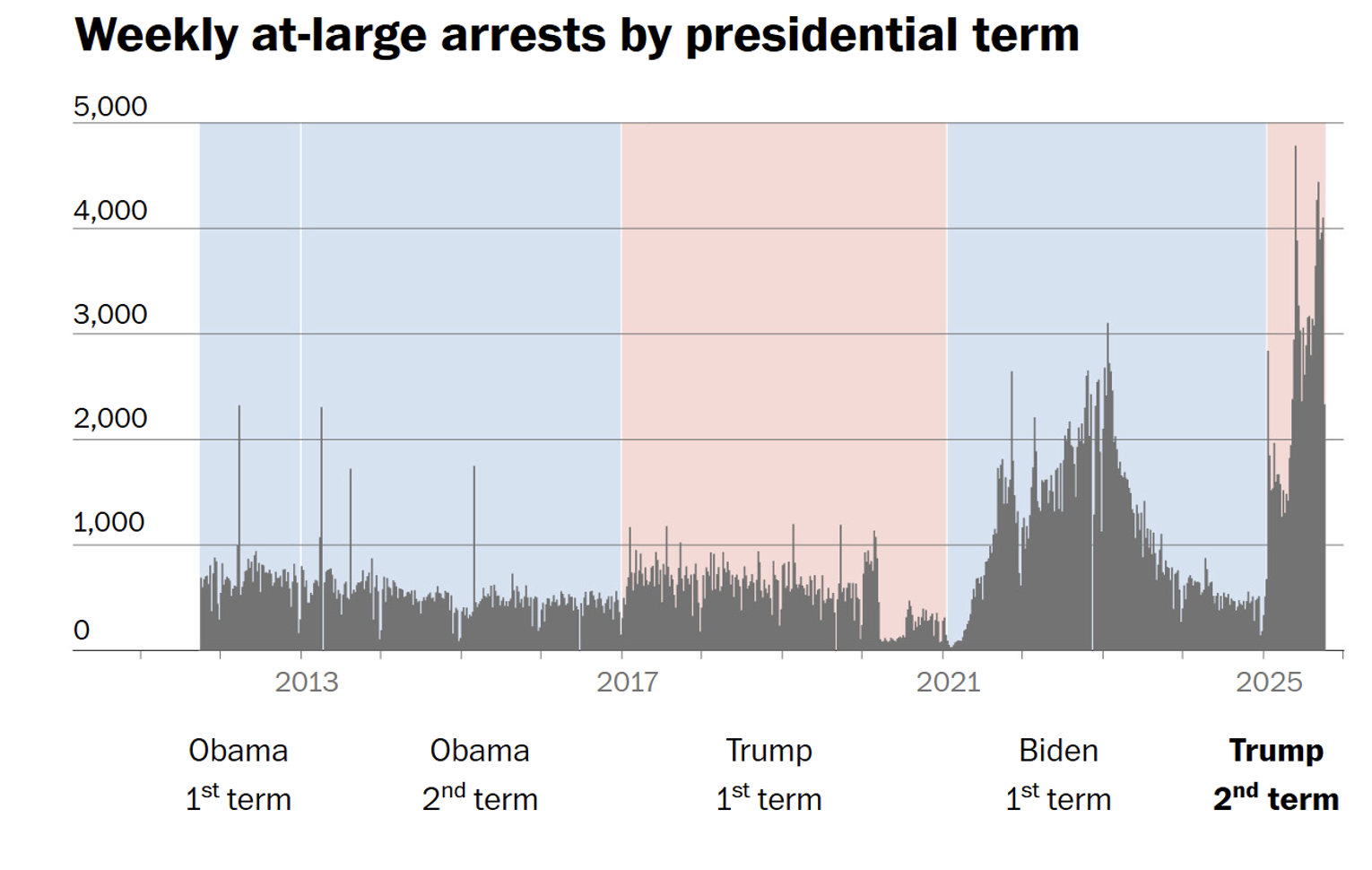
Figure 1. “Weekly ICE arrests per presidential term”. The Washington Post. December 28th, 2025.
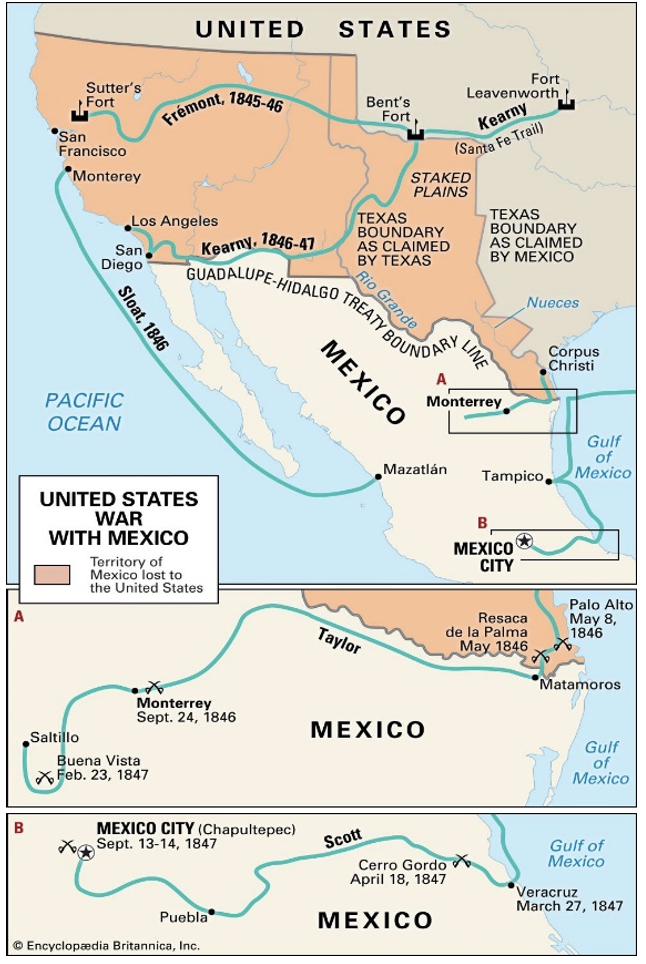
Figure 2. “Geographical Map of the Mexican-American War”. Britannica. Accessed January 10th, 2026.
Reuben Hey specialises in International Security and Relations, with a specific focus on North America, Europe, and Oceania.
Instagram: @hey_reuben