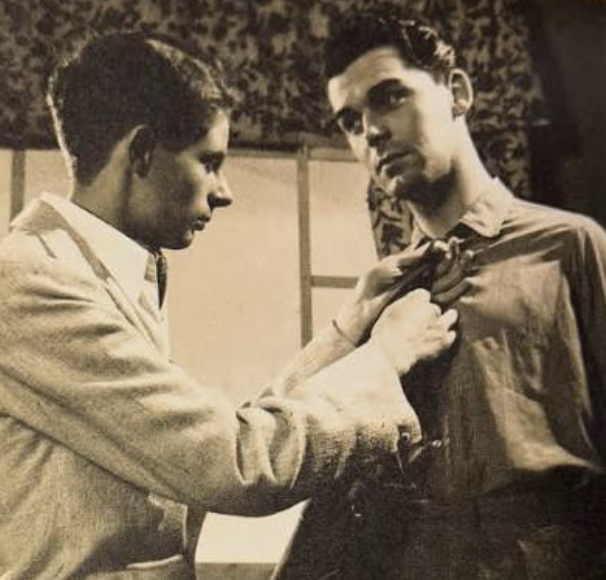
James Courage, right, with a friend
On 12 January 1959, the day A Way of Love was published, New Zealand author James Courage wrote in his diary that he felt as though he had thrown himself, “as a homosexual, on the hostile mercy of the world.”
Melodramatic, perhaps, -Courage had a flair for the dramatic - but also an accurate description of what it meant to publish a novel about love between two men in 1959. Even so, he continued, “I suppose I had to write the book, had to publish it, had to feel as I do. It was in me and had to come out.” Courage wanted to write honestly. He was also aware of what honesty might cost him.
I came across these lines and many more while researching A Way of Love for Lurid Editions, who are preparing the very first new edition of Courage’s novel since it was published. The work has led me through old periodicals, censorship records, literary criticism, archive catalogues, and diary entries, into the strange afterlife of a book that was once treated as dangerous just because it insisted that queer life could be written about seriously.
Reading Courage in June gives the story a particular charge. Pride Month asks us to think about visibility, survival, and the joy of being in community. Men’s Mental Health Awareness Month asks a related question from another angle: what happens when shame and secrecy make honest speech feel impossible? Courage, who lived with serious mental illness throughout parts of his life, and underwent forms of Freudian psychotherapy that now read as intensely unsettling, sits at the meeting point of those two conversations.
A Way of Love is often seen as the first gay novel by a New Zealander, though its world is almost entirely London. The novel is narrated by Bruce, a man in his mid-forties, shortly after the end of an intense three-year relationship with Philip, a man twenty years -or thereabouts- his junior. One of the best things about the book is how little it treats queerness itself as a source of guilt or tragedy. Courage’s writing is elegant and undemonstrative; the difficulty lies not in desire itself, but in the repressive laws and social fears that shape how desire can be lived. Bruce moves through a recognisable gay social world of parties, dinners with long-term couples, drag performances, snobberies, jokes, and coded intimacies. It is Philip’s fear of that world, however, and his inability to fully accept the life Bruce offers him, which gives the love story its tension. Courage may not write sex explicitly, but he never pretends the relationship is purely sentimental; what he does is normalise a relationship that the culture around him still treated as suspect.
Even this was too much.
In New Zealand, the book was brought before the committee responsible for the censorship of indecent literature, and was subsequently withdrawn from circulation. Though living in the UK since his university days, James Courage was, at heart, a true Kiwi and was devastated. He never returned to his home country again. This is one of the strange things about reading historical queer writing now. Texts once treated as scandalous can appear to us almost painfully restrained. Courage himself called this work “a mouse of a novel.” The novel’s ‘crime’ was not explicitness but the act of representation itself: the mere suggestion that queer love was not vice, pathology, or comic deviance, but a serious subject for literature that did not have to end in tragedy.
One of the lines that has stayed with me most comes from within the novel itself: “I want to read a novel about queers that treats us as human beings like other people.” It sounds almost like a manifesto smuggled into dialogue. It also sounds, more than sixty years later, like a statement of the obvious. But the history of A Way of Love reminds us that the obvious had to be fought for, and is still being fought for. To ask to be treated as human in fiction was already to make a demand on the world, something to which I am sure trans people can relate.
What has also interested me while researching the book is not only the finished novel but the book before the book. The earlier titles. The revisions. The negotiations. The points at which the manuscript was made more respectable and less physically direct. Publication history can sometimes appear a dry matter of dates, imprints, editions, and reviews; with a book like A Way of Love, however, it becomes something much more complex. Every alteration raises a new question. What could be said? What had to be altered? What did a publisher fear? What did a writer internalise even before his work reached the editor's pen? This ecosystem of pressures is what the academic Chris Adams calls ‘the publishing closet’. It is what censorship does at its most insidious. It not only bans books after they appear; it alters the conditions under which they are written. It can enter the sentence before the sentence is finished -perhaps before it begins. Long before anything is published, the writer is already weighing art against consequence.
Courage was not new to this. In 1938, his play Private History, centred on a gay relationship between two schoolboys, was performed at the Gate Theatre Studio in London to considerable acclaim. The Gate operated as a private theatre club, which gave it more room to stage controversial pieces. But when a West End transfer was proposed, the play came up against the Lord Chamberlain’s Office, then the official theatre censor in Britain. The public production was refused a licence. Two decades before A Way of Love, Courage had already written something that tested the boundary between what could be spoken in private and what was permitted to be shown in public.
This earlier episode demonstrates that A Way of Love wasn’t an isolated act of bravery. Courage returned, again and again, to the problem of how queer life could be represented. He wrote into a culture that gave him very few usable forms. He was not writing after liberation, or even on the brink of it. He was writing in a world where the law, the censor, the critic, the publisher, and the family were all direct forms of pressure.
Nor did this pattern end with Courage’s death. In 1997, when Peter Wells and Rex Pilgrim published Best Mates: Gay Writing in Aotearoa New Zealand, Courage was slated to appear in the anthology, but permission was refused by his family. His place was marked instead by a blank page. It is a telling absence: even in a book dedicated to gay writing, Courage’s work was still withheld, leaving silence where a literary ancestor should -and could- have been.
This is why Courage’s story complicates the language of visibility. Pride often asks us to celebrate being seen, and rightly so. But Courage reminds us that visibility has never depended only on courage. It has always depended on access and on others - peers, audiences, critics - on whether they are willing to not to look away. Choosing to be seen can also mean exposure. Publishing can feel like offering oneself to judgement. Writing honestly involves the fear that the world will misunderstand you, punish you, pity you, or look away -a fear that is not only historical, or only writerly. Many queer people still know the strange double bind of wanting to be known and fearing its consequences.
Courage’s work also speaks persistently about men’s emotional lives. Reading his diaries and fiction, it is hard not to notice how often questions of masculinity, desire, and loneliness sit close to the surface. So many conversations about men’s mental health and queer life return, eventually, to the difficulty of speaking: the effort of making oneself legible without becoming unsafe. One line from A Way of Love puts it simply: “The world always insists that one wears a mask.” The sentence speaks to anyone who has learned to edit themselves for safety or survival.
Yet Courage did publish the novel. He did throw himself on the hostile mercy of the world when he could have left the work unwritten. Queer literary history can easily become a history of harm: censorship, erasure, loneliness, illness, rejection, bad reviews, lost manuscripts, scattered archives. Though undoubtedly a reality, it is not quite the whole story. The other side is, indeed, courage - the authors and editors who did it anyway, the readers who recognised themselves, and the writers and editors and publishers who return later to the work and ask what was missed.
One of the things a reissue can do is refuse the idea that a book belongs only to the moment that first mishandled it. It allows the work to return, not cleaned of its history, but carrying it with pride.
To republish Courage now is not simply to rescue a forgotten gay novel. It is to place it back into conversation: with queer readers, with New Zealand literary history, with censorship, with the history of publishing, and with the long, and growing, record of books that are made to seem dangerous.
Pride month often asks us to celebrate visibility. Courage’s story asks us to think about what visibility has cost, and why, despite that cost, people have continued to write themselves into view.
That is the hope I find in A Way of Love: not a simple hope, nor the hope of a world that suddenly becomes merciful, but the hope of sentences that survive their own fear and become a book that had to come out; The hope that someone, somewhere, might read them and feel less alone.
Elio Andreu is a British/Spanish editor and archivist. He is passionate about history, queer culture and experimental literature
James Courage’s A Way of Love will be republished September 24 (https://www.lurideditions.com/
shop/p/a-way-of-love-pre-order)