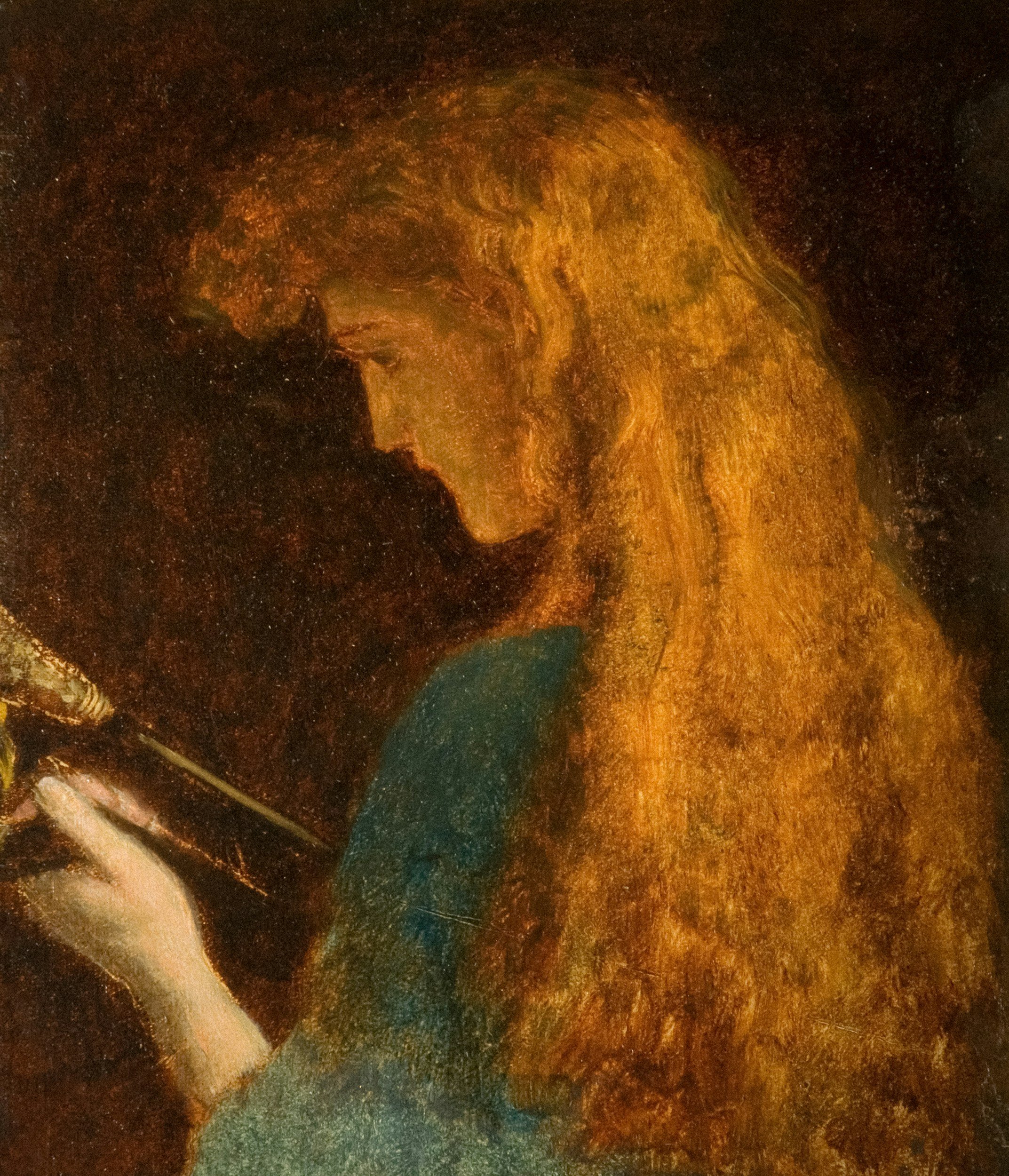
Many people know of the Pre-Raphaelite Brotherhood (PRB), but did you know it was also a sisterhood? While names such as Millais, Rossetti and Holman Hunt have received their accolades for centuries, there are powerhouses who are not given enough recognition. Joanna Boyce, Marianne Stokes, Emma Sandys and Elizabeth Siddal are only a few names to mention. Women artists have been overshadowed by their male contemporaries for too long, so let's blow the dust off of the history books and start at the beginning.
It’s time to uncover Elizabeth Siddal.
Mostly recognised for her relationship with Dante Rossetti and modelling in works like Millais’ Ophelia (Tate Britain), Siddal was at the centre of the nineteenth century artistic hub. While the esteemed Royal Academy of Arts preached tradition and classical compositions, the PRB audaciously rejected this. They took inspiration from Medieval-esque literature, The Canterbury Tales in particular, the work of the Old Masters and nature itself. With their jewel tones and controversial realism, the PRB were among the first to throw a cog into the machine of art.
Yet historians and authors too often favour Siddal’s legacy as a fanciful tragedy, no more than a mimic of Ophelia. Beautiful, grief-stricken and doomed. She has unfairly been imagined as an esoteric muse who helped elevate Rossetti to greatness, when in reality she was an accomplished artist who embodied the Pre-Raphaelite spirit. Her oeuvre is political, personal and defiant - demanding attention.
In typical Pre-Raphaelite fashion, Siddal produced drawings and paintings influenced by The Canterbury Tales and literature of a similar vein. Arguably, her most compelling work is The Lady of Shalott. A popular Arthurian heroine within the PRB, from Lord Tennyson’s poem, who is trapped in a tower on an island close to Camelot. The Lady is cursed to view life only through a mirror and forbidden to look directly out of the window. Until she falls in love with Sir Lancelot upon glimpsing him. She finds the courage to leave her tower, only to die en route, never making her love known.
Earlier renditions often depict her as a fallen woman: tragic, sensual, immoral. For instance, William Holman Hunt’s painting carefully chooses to depict the moment the Lady of Shalott spots Sir Lancelot, it is the moment of rebellion. It is a poignant tale of oppression and considered a representation of womanhood, so it is no accident Holman Hunt decided to illustrate the Lady of Shalott as a fallen woman. Her hair wild, chaos of threads and a cracked mirror illustrate her abandonment of duty and her defiance of Victorian gender norms. This interpretation is a narrative of womanly sin.
On the other hand, the women empathised with the Lady’s isolation, her sacrifice for love, and lack of agency. Siddal depicts the Lady of Shalott not as an immoral harlot, but as a real woman simply weaving with her back to the world that is out of her reach. It is less theatrical, but it encapsulates PRB women’s radical ability to not only adapt literary pieces but provide their own perspective. Siddal, who had to defy the restrictions of being a woman artist, offers the Lady of Shalott as a fallen woman not for her lust, but for breaking from the cage set upon her by society.
The genius and emotional intelligence possessed by Siddal gave her the ability to challenge the perverse notion of an adolescent girl discovering her sexuality. As Helen Nina Taylor states, Siddal was “unafraid of powerful women”, her characters are noble and multi-faceted, subverting societal expectations. Ironically, due to a lack of consideration towards women artists, they enjoyed a greater freedom to be non-conformist without the public scrutiny compared to male artists. Sometimes there can be liberation in the shadows.
Unfortunately, Siddal’s biography was cut short. After intense years of child loss, illness, addiction and heartbreak, Elizabeth Siddal died of a laudanum overdose at 32. Rather than her work gaining posthumous fame, Siddal was bound to Rossetti’s grief. The man who was the embodiment of infidelity. His guilt and heartbreak guided his paintbrush in those years after Siddal, turning her into a prop as her artistry faded.
And yet Siddal was far from the sidelines in her lifetime. She was offered financial patronage by John Ruskin. The same man who continuously doubted a woman’s artistic ability. This feat alone was not enough for Siddal, as in 1857 she contributed several of her works to an exhibition organised by the Pre-Raphaelite Ford Maddox Brown, earning praise from her colleagues.
It is a tragedy that history has chosen to remember Elizabeth Siddal as someone else’s story.
This great injustice is not unusual. Women throughout history have been condemned to being forgotten, while men’s names live through eternity. Revisiting names such as Siddal is a responsibility we must share. We owe it to the women who don’t have a voice. We must look further.
Hi I’m Jaz! I’m an aspiring journalist, check out my socials @unde.rthewillowtree :)