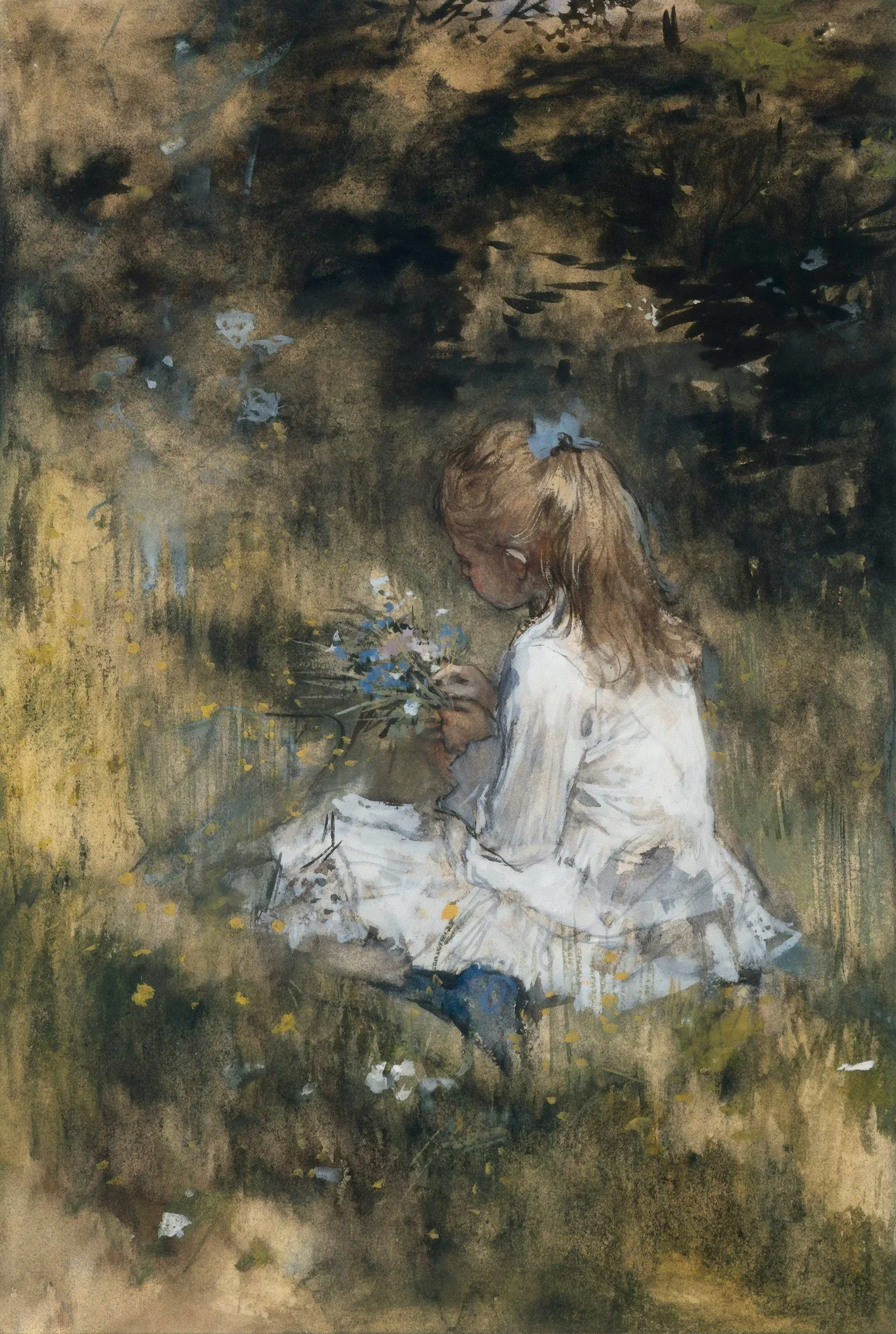
The dolls had descended as if from the heavens. They were flung from great, careless hands, and fell, fell, fell, onto inhospitable beds of wood and stone, the edges of outside penetrating the softness of their cotton bodies, their porcelain heads. They were not meant for such an environment. One would wear a crack on his face for the rest of his days.
“What will we do?” Shirley asked her companion Andy. They’d been named for characters long since forgotten by their gods.
“Maybe they are looking for us,” said Andy, always hopeful. He rubbed the crack that had taken out one of his bright blue eyes, feeling with his fingers for the shattered porcelain along the moss. One edge he found, but it seemed no longer to fit in the delicate curvature of his painted face. It had more in common, now, with the dusty crags that surrounded them.
The dolls waited and waited, for their cotton legs were no good for walking. Night fell and the music of day-birds surrendered to longer, more sinister calls in the sky, and movement in the brush. The dolls were afraid.
When morning came a fox approached, sniffing the linen of Shirley’s skirt. He nipped, just a little, to test what lay inside.
“Ouch! Do you mind!” Shirley cried.
The fox tilted his head. “What are you?” he asked. “You smell of food but have no taste. Are you even alive?”
“I don’t know,” Shirley admitted.
“We fell,” Andy supplied. “From up there.” And he raised his head meaningfully toward the sky, which seemed so far away now.
The fox looked up, too. “Gifts of the sky. How curious. But surely you’re not birds.” He nudged Andy with his nose, as if willing him to fly. Andy only stared at him. “How long do you expect to stay?”
“We don’t know,” Shirley said.
“Not for long,” said Andy.
Fox tilted his head. “I’m not convinced you know much at all about your state. You’re quite dirty, which tells me you can’t care for yourselves. What do you eat? Can you hunt?”
“Sometimes we have tea,” Shirley said primly, and the fox released a series of short barks that could perhaps be laughter.
“No tea here,” he said. In that moment, a snake slid across the leaves. Shirley and Andy shrank away but the fox calmly placed a paw right on the end of the shiny black body.
The top half of the snake rose up in instant offence. “We have no business, Fox,” she hissed. “I strongly suggest you release me if you value that limb.”
“Sorry to bother you, sister, I have an inquiry.” The fox tilted his head toward the dolls. “Look at these.”
Shirley and Andy held each other as Snake drew her head near their faces, her wide-set eyes reflecting their fear even as her nose poked studiously against the porcelain of their rosy cheeks.
“Strange beasts,” Snake said. “Maybe good eating under those shells.” She slid her tongue suddenly into the crack in Andy’s face, to which he wailed piteously. She ignored him. “Hollow as a rotted tree. Curious.”
“Perhaps they are dying,” Fox supplied.
“We are not!” Shirley insisted.
Snake examined her face with more interest. “When someone tells you what they are, it’s best to believe them.” She turned, then, to Fox, subtly removing her tail from under his paw.
“They seem useless and have no people,” Fox added meaningfully. Slowly, Shirley and Andy began to loosen their holds upon each other. Sadness filled their little bodies. “People are important for surviving in the forest.”
“Are you trying to enlist me?” Snake hissed. “I’ve plenty of friends, and am very busy besides.”
“You are not,” Fox chuckled, and Snake, again, looked deeply offended.
But she relented in the end. “Fine. I will help for a little while, today, but I’ll be hungry soon and haven’t much interest in this situation.”
“What a sport you are,” said Fox gamely.
“We should build them a shelter, perhaps.”
“Let’s find help.”
Shirley and Andy warmed to this idea. And as Fox and Snake considered who else to draw into their project, they began to dream of what kind of house they wanted.
“I’d like pink walls and curtains,” said Andy, “and a great table for entertaining.”
“And a bed of feathers!” Shirley added, “with quilted blankets.”
Fox and Snake gazed evenly at them. “Don’t get too excited,” Snake said. “You may want much, but it’s hardly the same as needing.”
“You go this way, I’ll go that way,” Fox said to Snake, and the two parted, leaving Shirley and Andy alone in the place where they fell. But some time later, they reappeared, bearing more companions, and resources besides. Snake drew twigs together to form the base of the shelter, which Spider knotted tight with fine sticky silk. Rabbit lifted herself on her hind legs and lined the walls in thick glossy leaves. A great hawk came, and though Rabbit trembled at the sight of her, she contributed her feathers, organising them neatly in the form of a generous nest without giving Rabbit a second glance. The Owls promised to deliver news in the night; Rats brought food, and even tiny tree seeds, cut open and filled with water, so Shirley felt she was having high tea.
“Strange company, this,” Snake hissed, and Fox patted her lithe black body in a friendly way this time.
“We all need help sometimes,” he said.
“Pray we don’t regret it,” Snake replied.
“Such a pessimist!”
Wolf came then, trailing her pups, and Shirley and Andy played with them until they were tired. Before the animals parted, Snake gave them one last look. The Dollhouse was a fine structure now, great and green and lit on the inside with the generosity of a few fireflies.
“Today you found people,” Snake said. “Don’t forget who we are. People are indebted to one another.”
Shirley and Andy thanked their friends, and promised not to forget.
For awhile, they lived well in the forest. They learned to clean themselves and forage on the backs of Rats, and the Owls shared news of the world they left. Every day they felt a little more real, a bit more strong, and they began to eat. But they always remembered to share their newfound bounties and discoveries with their friends, beside whom they lived happily.
One day, while foraging for berries, Shirley encountered a new Snake. “Hello, friend,” she said, and reached her hand out. It felt softer now, infused with life … but the Snake, alarmed, darted forward and cut into her with its sharp fangs.
“Ow!” she cried, and ran home, for by then her legs were strong, no longer soft and stuffed as they had been in the old times. Andy dressed her wound and sucked out the venom as their old Snake friend had taught them.
“You must be careful,” he said. “We’re changing. And though we’re not as soft and fragile as before, we are fragile in new ways.”
Shirley agreed. But, still high from fear, she suggested they build a wall around their house, just in case. So they gathered stones and stacked them high like herms, until the Dollhouse resembled a fortress. But the Fortress posed a new problem, for while it was difficult to get in, it was also now difficult to get out.
For a time, this was not so bad. The Rats continued to come with food, the Owls with news, Hawks with feathers for warming them, Rabbits with fresh leaves. Sometimes even Wolf came, bearing skins from her kills for colder nights, for she saw that the skins of the dolls were thin and made no fur.
Something changed after the snakebite, and the making of the wall. Shirley and Andy began to notice things about their friends that they hadn’t before. The Rats were efficient and taciturn, but their teeth were long. Hawk’s claws were sharp, and once, while still waving goodbye, Andy saw her dart downward and take a dormouse in her grip, barely smaller than Shirley and Andy themselves. Even Wolf became suspect, for her pups, while initially sweet and playful, had begun to grow. They looked at Shirley and Andy with a different kind of interest now.
“We won’t have to go out so much, or rely so often on the kindness of strangers, if we had food and resources closer by,” Shirley said, ever practical.
“But are they strangers?” Andy wondered. “Snake said they were our people, and we can’t forget.”
Shirley squeezed her eyes closed. “Maybe some are our people. But not all. And maybe one day even the ones who are will forget.” She rubbed the place where the Snake had pierced her.
Andy dug a moat; he was becoming quite hardy. Then he went and spoke to Beaver, and learned how to redirect water from the stream to their home, so water twisted along the forest floor and pooled safely around their Wall. And, taking cues from the trees which dropped their seeds forever into the earth, they began studying how plants grew, and started to work the land.
When, in the harvest season, the Rats came with their usual share of food from elsewhere, Shirley and Andy thanked them for their service and said it was no longer necessary. And when Hawk and Wolf came with their customary gifts of fur and feathers, they, too, were discharged, for Shirley and Andy had learned to sew. Even Rabbit was turned away, for, after seeing how often the leaves that composed their walls needed replacing, Shirley and Andy had begun gathering reeds and twigs, braiding them together to form stronger reinforcements that required less upkeep.
When the sun grew lower in the sky, Fox and Snake crossed paths again, not far from the Dollhouse, which was now getting quite big indeed. It was now fully half the size of the tree upon which it once leant; the trunk now served as a reinforcing column that held up many floors of the great House. The stone Wall was taller and more formidable. And the land around the space looked braided and tilled, the natural chaos of nature giving way to neat rows of yellow, green, orange and red that Rabbit was now discouraged, in surprisingly unfriendly ways, from visiting.
“Seems they’ve made a go of it,” Fox said.
“Thanks to us,” Snake added, watching Andy of the single eye till the earth while looking uneasily up at the sky.
“I’m proud of our handiwork,” Fox said. “Have you heard? They don’t even need the Rats anymore.”
“I’m not so sure what we have to be proud of,” Snake replied. She was shedding, and grumpy. Fox nipped at her loose skin to help, but she batted him away. “You don’t know where it itches,” she snapped. “And it’s tender all over.”
“Sorry,” Fox said congenially.
“So they’ve sent the Rats away,” Snake went on, picking up the thread, for she had a horror of being rude. “I’m not sure this is good news. They used to share and say hello. Now they are strong indeed and don’t share at all, have built walls, and are manipulating the seeds, water and the sun.”
She tilted her head upward and Fox looked: Indeed, the Tree that supported the Dollhouse bore fresh wounds, where young branches had been cut so the sun and rain would fall directly onto Shirley and Andy’s patchwork of crops. Beetles filled the wounds, and fungus. He knew the Tree would lose integrity sooner than it would have, for it had been strong and strategic in its growing.
“Interdependence is indebtedness,” Fox offered, for he was always optimistic.
Snake, who kept her opinions closer to earth, like her body, hissed sharply in response. “They are still interdependent”—gesturing, now, to the tree—“but perhaps no longer see they are indebted.”
Fox said nothing.
“When last did you speak to them?” Snake asked.
“Oh, moons ago,” Fox said. “I can’t recall now. But I’ve been busy. Clearly they have been, too.” He walked around the superstructure of the Dollhouse, playfully kicking stones into the moat, and Snake slithered along behind him. “Oh! That’s new.” Affixed to the wall was an effigy in the shape of a great Doll. Bound twigs composed her arms and legs, and she had dried berries for eyes and moss for hair. At her feet were many gifts: Fresh fruits and mushrooms, and even some meat. But Fox could not draw near to sniff the meat, because a gate of sharpened wooden stakes, criss-crossed one over the other, blocked his passage.
“Perhaps they grew lonely,” Fox mused.
“That is a god,” Snake hissed. “They no longer see us. They look outward, upward, up from where they fell. This is what they do, now, with the gifts they once shared.” She began to slither away, and as she did, left a whole skin behind—a skeletal version of herself, transparent and crispy.
“You’ve made a sister,” Fox joked, poking at the skin with his nose, and marvelling that something that, just moments ago, encased life now felt cold and quite dead. Snake ignored this comment. But before he trotted off, she turned back and said, “Their bodies are changing, too. They are meat now. Perhaps, next time I see them…”
“You can’t be serious,” Fox said.
Snake rolled her head mysteriously and vanished into the brush.
Fox felt anxious. But because this sensation was alien to him, and quite uncomfortable, he shook it off. “Perhaps I’ll find a chicken today,” he mused brightly, and in his turn, disappeared behind a chestnut tree, kicking the spiky seed pods ahead of him as he went.
Fox did not see Shirley and Andy again. But he did see their children, for they had many. And he lived to see many Dollhouses take up residence against other sturdy trunks, growing higher and higher, until eventually trunks themselves were used to compose the walls of each House. The forest changed, and hardy spaces became clearings, then walled gardens. The Dolls grew tall and made everyone nervous. Even the Owls stopped bringing news, and took night purchases further away, remarking only to each other on new Dollhouses made, new trees cut, new traps cutting into the animals that once were kin.
Ironically, there were more chickens around now, in Fox’s old age. But they were barred from him with traps and razor wire, and his gums were soft and his legs no longer quite so quick. His perimeter was wider now. Food grew hard to find, and he began to avoid the sound of shoed feet.
Snake had long since died. He no longer remembered when, nor how. He saw her children from time to time, but they were not as sociable as their mother, sliding away from the vibrations of his footfall without so much as a glance. As the forest grew thinner, subject to the growing requirements of the Dollhouses, it also became introverted and chilled, as if some aspect of it had inherited the DNA of the dolls who, once helpless, so quickly grew hard, even as their porcelain grew soft and warm and filled with blood.
“How things change,” he mused.
Angela Natividad is a writer and mythologist based in Paris. She is also, now, a mother, which has made her a bit strange.