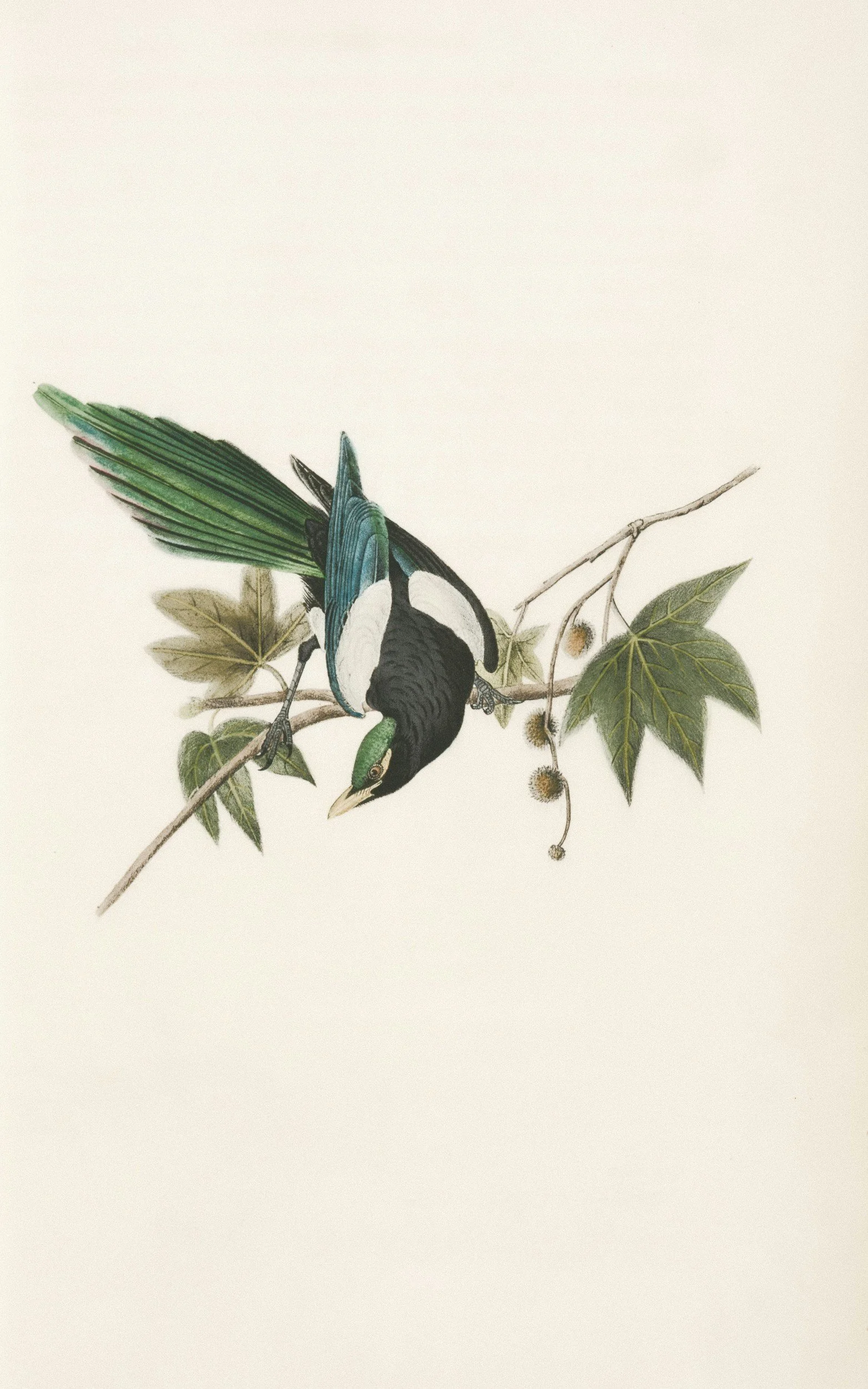
They bring the bird in and it’s a handful of disgruntled feathers, clutched in the well of Tommy’s fingers. I know the frantic sound of its complaints only too well. The origin of its defensiveness is tucked against the flash of white: a crooked wing bent up in pain. I stare at it and I already know how this is going to go.
“What is it?” Jenna asks.
“It’s a magpie– No Tom, not on the table!” All three of them freeze in shock, a tableau of my greatest achievements, and I hurry to amend the outburst for the sake of wiping that look from their faces. “Here, on the floor. Put it by the Aga; it’ll be warmer there.”
We crouch around it, a huddle, staring down at this one, lonely, frightened thing. Its eyes are two deep holes in its head; wide and black.
“What do magpies do?” Jenna asks.
“They steal things,” I reply. “Shiny things. Precious things.”
“Why? Do they eat them?”
“No,” Jack answers, inflated with importance. “Of course they don’t eat them.”
“What do they do with them?”
“I don’t know, Jen,” I say. “They just like to collect them.”
Tommy tears a chunk away from the fresh bloomer on the countertop.
“No.” I stop him. “Bread isn’t good for birds.”
“But what about the ducks on the canal?”
“You’re not really supposed to feed them bread. You’re supposed to feed them corn and grains and things.”
“What about magpies?” Jenna asks, looking up at me.
“I don’t know. I think they eat bugs. Insects.”
“Spiders?” Jack exclaims.
We have plenty of fat black things that squat in the corners of our converted farmhouse. Not that its drafty doorways and shallow rooms are ours, not really, but we’ve been here since Jenna was born and I couldn’t bear to uproot them again, even if the rent is a stretch. They know every nook and cranny of it, every eave and crawlspace. With one nod from me, my children scatter like marbles and race to be the first to tease an unsuspecting victim into the open. I’m left with the bird.
I find a cardboard box and line it with kitchen towel, listening to the sound of half-sized footsteps creaking on the boards above. It’s hard to remember a time when I had such a lust for poking and prodding at things that scuttle. Before I became a mother, certainly. Before the articles and newspaper clippings about false widows that my own mother kept were pinned to the refrigerator as a warning and I became too afraid to gaily throw my hands into punnets of supermarket fruit. Back when I was Jack’s age, maybe. By the time I’d turned twelve, I’d found a bird of my own to bring into the kitchen. It was a blackbird. A fox had tried to take its leg.
Before dinner, I make them all wash their hands.
“But why?” Tommy moans, hating any ritual involving soap. It’s a phase, I tell myself, he’ll grow out of it.
“Because it might be carrying a disease. We don’t know.”
“But it doesn’t look diseased.”
“Yeah, well, sometimes you can’t tell,” I say, double-pumping the dispenser.
I watch them at the table, captivated, twisting in their chairs to get a better view of the box. Feeble chatters emerge as it picks at the crushed granola bar; the only thing I could muster after all of them came back spiderless. It’s when it goes quiet that I have to worry. It’s when it stops eating, when it tucks its head beneath its crooked wing that I have to think about how I’m going to explain death to them, how I’m going to talk about dying. They’ve never had a cat or a dog or even a goldfish. They don’t know what death is.
“Jack,” I scold. “No phones at the table.”
“But I’m messaging Dad,” he says, his lasagne only half-devoured. “I want to tell him what we found.”
I sigh, cornered by the impasse; I know that Will won’t reply.
I take them out to the cinema even though I know it’s too late for Jenna to be up. Maybe I think it’ll be easier if they come back to find the magpie dead already; it was one thing and now it’s another. Two different states and no messy transition in the middle. Or maybe it’s because I’m still trying to make up for our own messy transition: the listlessly flung accusations, the protracted paperwork. Even with all of his new-found free time, I know that Will would never do these things with them. I let them get popcorn. I let them pick movie magazines from the stand and shred them in their laps while the film plays. I let them sit until the very end of the credit roll when the rest of the seats have emptied and, for a moment, the whole cinema feels like it’s ours. They go to bed exhausted and happy, the bird forgotten for now.
I read for a while in the dim light of the lounge, my sentences punctuated by subdued cackles from the other room, and then, when the letters start falling together, I get up from the window seat and do the things that Will used to do, the things that made me feel safe. I double-lock the front door and pull the curtain across. I put my hand against the gas fire and make sure that it’s stone cold. I hide the backdoor keys in the cupboard, checking that every one is accounted for and, finally, I force myself to go and check on the bird.
But it’s not alone. Jenna is crouched over it, her face in profile, staring down into the box. I stop myself in the doorway. She hasn’t heard me yet and it feels like a rare thing: to get to watch her, suspended, like this.
I used to think that she was all Will, that they were all all Will; his haphazard curls, his pretty pinched mouth but I see her with her nose disappearing between the cardboard and, for a moment, there I am. Swaddled by the kitchen shadows, she is me, watching over her bird. Her bedding is gathered around her on the floor, her own little nest.
“Mummy?” She looks up.
“Sweetie, it’s late, what are you doing?” I ask even though I know the answer.
“Can I sleep here tonight? I don’t want him to be alone.”
“Jen...” I crouch beside her, glancing over the lip of the box to check the frightened creature pressed against its edges. How huge we must look. “You know there’s a chance that...”
“That what?”
“That it might not make it...”
“How do you know?” she asks insistently.
“Well, when I was just a little bit older than Jack is now, I found a bird like you guys did but it was very poorly and it didn’t survive because... sometimes things just happen and we might not want them to but they do.”
“Was it a magpie?”
“No, it was blackbird.”
“But that’s different,” she says. “See? I’m going to make him better.”
I look into her face. The moment’s broken; she doesn’t look like me anymore or, rather, I don’t look like her anymore. That certainty in my jaw is gone; the self-assuredness that everything will be alright. Because it isn’t. It isn’t always alright. I sat up all night with my blackbird, passing gentle shushes between my lips every time I saw it shudder but, in the morning, we were both cold and stiff on the kitchen floor and one of us was lifeless. I grew up. Not in the course of that one night but from then onwards in a long, drawn-out, painful way. Age. It steals things from you, precious things like hope, so light-fingered that you don’t notice them disappearing until it’s too late. Growing up, growing old, that’s the real thief. I look at Jenna and wonder when it will visit her, steal this assurance in her sleep, piece by piece.
“Come on,” I say, “you need your real bed.”
She protests and squirms in my arms.
“Who will watch out for him?”
“I will.”
“Do you promise?” she asks.
“I promise I’ll do whatever’s best for him,” I answer carefully as I carry her upstairs.
The magpie is alive but only just. I watch it for a while, feeling the ghost of my younger self at my elbow. I’ve changed. It’s not just the tired eyes that I see in the mirror, it’s the tired optimism. It’s worn thin inside of me like an old elastic band; pulled taught and tested too many times.
I take the bird outside, tucking it under my arm. It barely has the strength to protest; its beak nips me once and then rests against my bare skin, flat and shiny like a sea-worn pebble. I should have let my mother take my bird to the shed. I should have let her put it out of its misery but, instead, I stared at it all night, my eyes forcing it to remain in this world and suffer. I should have let a lot of things end sooner than I did.
My hand comes down over its head and I feel the thin veil of its avian eyelid fluttering. One short, sharp crack and it won’t be suffering anymore... A light strikes the patio and I glance up to see Jenna’s bedroom window illuminated.
When she was still just a curled joy in my belly, I bought her a lampshade that looked like a carousel; something I thought would be pretty. It stayed on her bedside table, even after she outgrew the rest of her nursery decorations. Perpetually paused in motion, the glowing horses throw her curls into silhouette and I can’t tell if she’s scared or sad or just disappointed. Is this it? Is this the night that she begins to grow old; the first time she sees death? I’ve tried to keep them protected for so long. From this. From everything.
The three of us are frozen, mesmerised by one another: my daughter, the bird and me. I feel guilty, caught here, almost-red-handed, and I realise how wrong I am. There is no thief, no nest that age keeps for itself, filled with shiny, precious trophies; there’s only me and the things that have slipped through my fingers. I try harder to see my daughter’s face, to see myself in it again. These things aren’t stolen; sometimes they’re just lost along the way and maybe, the more I look up at her like this, the easier it will be to retrace my steps and find them again.
I take my hand away from the magpie’s neck. Maybe, this time, it will be different.
Amy currently lives on the south coast of England and, despite a perfectly lovely upbringing, has always had a passion for exploring darker themes in her work. She’s also a passionate believer in the beauty of human creativity staying where it belongs: in the hands of real, beautiful human beings. Her poetry and short fiction has been published internationally and she can be found online at www.amy-crosby.com or followed @officiallyamycrosby .